During April-August, the eight sectors grew by 4.4 per cent, against 4.2 per cent in the year-ago period.

Inflation trajectory does not match the slump in demand, prolonged pause on rates likely.

Continuing its dismal performance, industrial growth fell further to 1.9 per cent in September, mainly due to poor output from the manufacturing sector.

During April-September, the eight sectors grew by 4 per cent, against 5 per cent in the year-ago period.
India's industrial output grew 9.7 per cent in August compared to 7.6 per cent in the same month last fiscal.\n\n

Wholesale price inflation dropped to 0.85 per cent in April as prices of food articles, manufactured products, and fuel eased, government data showed on Wednesday. WPI-based inflation was 2.05 per cent in March. It was 1.19 per cent in April last year.

Inflows into equity mutual fund (MF) schemes declined in May, logging their lowest tally in 13 months at Rs 19,013 crore. It came even as the gross systematic investment plan (SIP) inflows surged to a record high of Rs 26,688 crore.

Production of eight infrastructure sectors rose at a three-month high of 7.4 per cent in December 2022 against 4.1 per cent in the same month of previous year on a better show by coal, fertiliser, steel, and electricity segments, according to the official data released on Tuesday. Crude oil output, however, contracted by 1.2 per cent in December last year. The production of eight key sectors rose by 5.7 per cent in November 2022.

India's annual industrial output growth slowed to 4.2 per cent in July compared with an upwardly revised 4.4 per cent growth a month ago, government data showed on Friday.

Manufacturing, which constitutes around 80 per cent of the index of industrial production, grew 19.4 per cent in April against 0.4 per cent a year ago, according to official data released on Friday.

Wholesale inflation rate eased to 34-month low of (-) 0.92 per cent in April on easing prices of food, fuel and manufactured items. The wholesale price index (WPI) based inflation has been on a declining trend for 11 months in a row and entered the negative zone in April. In June 2020 WPI was at (-) 1.81 per cent.

Analysts expect Nifty to rise up by to 6 per cent in six months, with intermittent corrections likely due to global factors.
According to the data released by the government, the capital goods segment in the overall industrial output rose by 63 per cent in July and pushed up the Index of Industrial Production (IIP) by 13.8 per cent.

Shares of Oil marketing companies (OMCs) extended their gains for the fourth consecutive session on Thursday after crude oil prices plunged to six-month lows in the international markets, which boosted investor sentiments. Traders said the OMC stocks gained with crude oil prices hovering below $70 per barrel after OPEC-plus decision to increase output from April, a move which is expected to favour Indian refiners with added marketing margins on retail fuel.
The country's industrial production has risen by 11.4 per cent in September 2006 over the year-ago month, powered by double-digit growth in manufacturing and electricity sectors.\n

The IIP data showed a significant slowdown in the manufacturing sector, which grew at 4.2 per cent in July 2019 as compared to 7 per cent a year ago.
India's industrial production rose 4.9 per cent year-on-year in April, the first month of the current financial year, the official Central Statistical Organisation said on Thursday.

Production of eight infrastructure sectors recorded an almost flat growth rate of 6 per cent in February as against 5.9 per cent in the same month last year, according to official data released on Friday. The growth in February is lowest in the last three months. The output of core sectors had increased by 8.9 per cent in January 2023 and 7 per cent in December 2022.
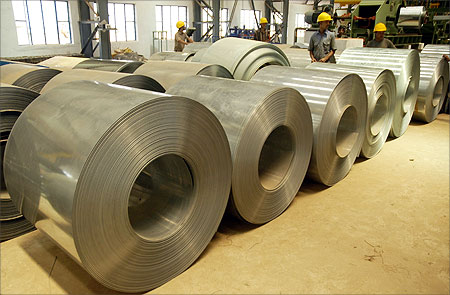
Industrial output fell 3.2 per cent in November.

The production growth of eight key infrastructure sectors slowed to a six-month low of 7.8 per cent in November due to a decline in the output of crude oil and cement sectors. The growth rate in the production of coal, fertiliser, steel, and electricity also decreased during November this year. According to the data released by the government on Friday, the growth during the month under review, however, is higher than the 5.7 per cent recorded a year ago.
India's industry sector grew by 6.7 per cent in July 2005 compared to 8.5 per cent in the same month a year ago.
The country's industrial output growth trickled to 6.2 per cent in October, the lowest this fiscal, on account of a slowdown in manufacturing production.

Macroeconomic data announcements, global factors and trading activity of foreign investors would be the key triggers for the domestic stock markets this week, analysts said. Last week, the benchmark indices joined the broader market's party despite a host of negative global cues. In the broader market, the BSE midcap and smallcap gauges hit their all-time highs on Friday.

From the Sensex pack, Tata Consultancy Services, HCL Technologies, Tech Mahindra, Infosys, Tata Motors, Bajaj Finance, Kotak Mahindra Bank, Mahindra & Mahindra, Bharti Airtel and Maruti Suzuki India, Tata Steel were the major laggards. PowerGrid, Sun Pharmaceuticals, UltraTech Cement, NTPC, Asian Paints, Nestle India, Titan, IndusInd Bank and Axis Bank were among the gainers.

Industrial production grows at 2.1 per cent in March.
The growth of eight key infrastructure sectors rose to 5.2 per cent year-on-year in March due to improvement in the output of crude oil, cement and electricity, according to official data released on Tuesday. In 2023-24, the growth rate in the output of these eight sectors was 7.5 per cent, marginally down from 7.8 per cent recorded in the year-ago period.

'The universe of PSU stocks is huge and diverse.' 'Investors should bet on specific sectors and stocks from the basket as most of them may continue to consolidate after years of outperformance.'
Inflation, remained in negative territory for the 7th month in May

Portfolio management services (PMS), catering to higher networth individuals (HNIs), are facing tough competition from emerging alternative investment funds (AIFs), evident from their dwindling client base. In May, the number of clients for the industry stood at 125,390, down 20,528 in two months, shows data from the Securities and Exchange Board of India (Sebi). "PMS managers also have a high active ratio, which means their portfolios are quite differently positioned and more actively managed, compared to the benchmark, which is also a highlight for long-term investors.
Buoyant manufacturing sector has pushed up industrial growth to 13.6 per cent in the first month of the current financial year against 9.9 per cent in April.

The core infrastructure industries had expanded by 5.2 per cent in the previous month.

Mutual funds (MFs) have significantly increased their ownership across market segments, but the midcap space stands out with comparatively higher growth. Data reveals that the number of midcap companies with over a fifth of MF ownership has doubled from nine in March 2022 to 18 by March 2025. In contrast, largecap stocks saw only a marginal rise, from three to four such companies during the same period.
As per use-based classification, primary good registered a growth of 7.4 per cent, intermediate goods 22.4 per cent, and infrastructure/construction goods 0.1 per cent in February 2020 as against the same period a year ago.
India's industrial output grew a better-than-expected 6.4 per cent in August compared with a downwardly revised 4.1 per cent growth a month ago.

From the Sensex pack, Reliance Industries, Bajaj Finserv, HDFC Bank, Adani Ports, Maruti Suzuki India, Axis Bank, Hindustan Unilever, Sun Pharmaceuticals and Asian Paints were among the laggards. Reliance Industries fell the most by 2.38 per cent to close at Rs 1,171.10 apiece.
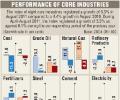
Eight infrastructure industries grew by 3.5 per cent in August this year, down from 4.4 per cent expansion witnessed in the same month last year.
As per data released by the government on Monday, industrial output grew by 3.5 per cent in the April-October period this fiscal, as against 8.7 per cent in the same period last year.

India's industrial output unexpectedly rose 1.2 per cent in May from a year earlier, led by a pick up in manufacturing, government data showed on Tuesday.

In comparison, industry grew by 2.1 per cent in May last year.
